“You cannot always control what goes on outside. But you can always control what goes on inside.” – Wayne Dyer
Regular meditation can help you to control your emotions, enhance your focus, and decrease stress. There are many different ways to mediate. The following steps can help get you started.
Step By Step Guide to Meditation
Choose a quiet, peaceful environment free from distractions
Wear comfortable clothes
Decide how long you want to meditate, 15-45 minutes is recommended
Sit in a comfortable upright position with your spine straightened
Close your eyes if it helps you to focus and relax
Follow your breathing
Breathe deeply, inhale through your nose then exhale through your mouth
Focus on your breathing and breathing only
Let all thoughts slide away and empty your mind, focus only on your breathing
Become aware of the rising and falling of your abdomen as you breathe in and out
Continue like this until your time is up.
Meditation takes practice. Don’t worry if you have trouble emptying your mind or become frustrated or easily distracted, just return to following your breathing. As you train your mind and body to relax through meditation, you’ll become accustomed to the routine and begin to associate deep breathing with stress relief. In the same way that pictures of food may make us feel hungry, meditative breathing can decrease our stress.
So, if you’re having a bad day and feeling under pressure, stop for just a moment to take a few deep breaths. The results may surprise you.
by Taylor Sullivan, M. Ed. | UAB Community Health & Human Services Alumni
July is Dry Eye Awareness Month
Dry eye is caused when the eyes do not make enough tears to stay moisturized or when the tears do not work correctly. Dry eyes can make your eyes feel uncomfortable and, in some cases, cause vision problems.
Dry eye is common and affects millions of Americans. There are several options available to help with dry eye while keeping eyes healthy and comfortable.
Symptoms of Dry Eye
Scratchy feeling as if something is in your eye
Stinging or burning feeling in your eye
Eye redness
Sensitivity to light
Blurry vision
Risks of Dry Eye
Anyone can get dry eye, but some are more at risk than others.
Those 50 years of age and older
Women
Contact lens wearers
Lack of Vitamin A
Certain autoimmune conditions
Too much screen time
Treatment depends on what causes your symptoms. Artificial tears are the most common treatment for mild dry eye. For severe dry eye, prescription medication may be necessary, but moisturizing gels and ointments are also available without a prescription.
Talk to your eye doctor today about dry eye and treatment and prevention options.
Brief Description: The human immune system becomes less effective at tackling infection or inflammation and less responsive to vaccinations as we age. This increases the risk of all age-related sickness. Fortunately, regular exercise, maintaining a moderate weight, and adopting the right diet may help a person maintain a healthy immune system throughout life and into old age.
Brief Description: For most older adults, good health ensures independence, security, and productivity as they age. Yet millions struggle every day with health and safety challenges such as chronic disease, falls, and mental health issues—all of which can severely impact quality of life. Get the facts on healthy aging and older adults: Chronic disease, falls, physical activity, oral health, and behavioral health are all topics older adults should learn about to ensure health and wellness as they age. The National Council on Aging Center for Healthy Aging provides chronic disease management, falls prevention, and other initiatives.
Title: What to Know Before Your Second COVID-19 Vaccines
Brief Description: Understand the do’s and don’ts of the two-dose coronavirus vaccination regimen. To be fully immunized, it’s critical to get that second shot. Your side effects will likely be stronger after the second dose. You should avoid taking pain relievers before your shot, but feel free to take them afterwards. The timing between doses does not need to be exact, though avoid getting the second dose too early; it can be given up to six weeks after the first. Your second dose should be from the same manufacturer as your first. A rash at the injection site is not a reason to skip your second dose. You should temporarily avoid all other vaccines. Full immunity is not immediate and won’t kick in till two weeks after your second dose. You still need to wear a mask as there is a small chance you could get sick or carry the virus and silently transmit it to others.
The COVID-19 pandemic may be stressful, but you can get through it. Take care of yourself and cope with the stress by addressing your physical, emotional, and mental health.
Take care of your Physical Health through
Eating a balanced diet
Regular physical activity
Plenty of good sleep
Avoiding excessive alcohol and drug use
Take care of your Emotional Health through
Connecting with others
Taking a break (unwinding)
Staying informed (but avoiding too much exposure to news)
Seeking help when you need it
Take care of your Mental Mealth through
Meditation
Connecting with your faith-based organization
Continuing with your treatment and staying aware of new or worsening symptoms
Calling for help if needed
Black Mental Health Resources
• National Suicide Prevention Lifeline (800) 273-8255
By Jaelyn Copeland (Community Health and Human Services Student), with contributions from Shayna Bryan (Intern & Community Health and Human Services Student)
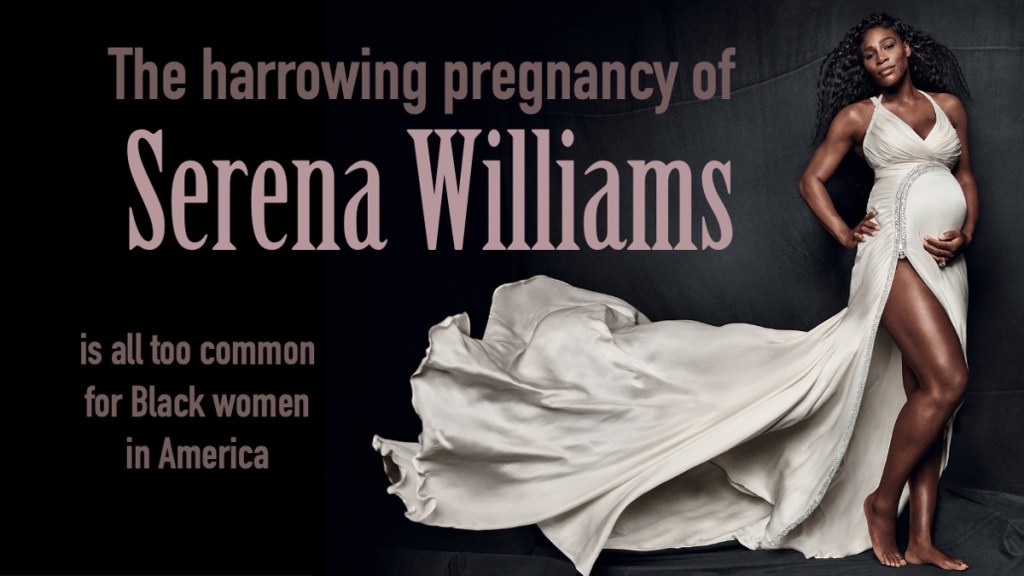
Original photography by Mario Testino for Vogue magazine
Maternal mortality rates in the United States have been increasing steadily year after year, placing the country 56th on the World Health Organization’s worldwide data set, which is near the bottom of the developed nations. This disproportionately affects black women, who face not only the typical health hazards that come with childbirth, but must also wrestle with racial bias in the medical industry
Did you know black women are three times more likely to die due to pregnancy-linked causes than their peers?
According to the CDC, for every 100,000 births, 37 black women died in comparison to 15 white women and 12 Hispanic women. The causes of these racial differences are numerous. One of the issues is a lack of access to health care and poor quality of service. However, CDC data shows that even college-educated black women die at higher rates from pregnancy-related causes than white women who did not graduate from high school.
Look no further than Serena Williams, one of the greatest professional tennis players in history and an overall acclaimed athlete with a net worth over $200 million, whose pregnancy story demonstrates that these issues penetrate every level of society. In an interview with Vogue, Williams recalls battling with major problems shortly after the birth of her daughter. After her daughter was born through Cesarean section, Williams became short of breath. Knowing her own history of blood clots in the lungs (called pulmonary embolisms), she instantly alerted a nurse to her symptoms. However, staff were slow to respond to her concerns. The resulting complications ended in Williams needing a filter inserted into one of her major veins. It took six weeks of bed rest before she eventually returned home.
Serena’s traumatic story places her among the 50,000 women in America who face dangerous or life-threatening pregnancy-related problems each year.
However, researchers suggest this estimate may still be too conservative. Racial bias in the medical industry is a systemic issue that is becoming more recognized. The CDC has launched the Hear Her campaign to spread awareness and education on the complications associated with pregnancy. The lesson for the medical industry is to listen to patients more and make sure their needs are addressed. For the rest of us, the lesson is to learn to be your own best advocate.
Here are steps you can take:
Enroll in pre-natal care early, 1 month before pregnancy if possible
Take pre-natal vitamins as early as possible, even before becoming pregnant
Vitamins like folate are essential to brain and spinal cord development which occurs during the first few weeks of pregnancy
Learn the warning signs of common complications, particularly those you are at high risk for and those in your family medical history
Testino, M. (September 2017). Photograph of Serena Williams. Vogue.
WHO, UNICEF, UNFPA, World Bank Group, and United Nations Population Division Trends in Maternal Mortality: 2000 to 2017 Geneva: World Health Organization, 2019. Retrieved from: https://data.worldbank.
A good night’s sleep should not be taken for granted. Not getting enough sleep is linked to increased risk for type 2 diabetes, heart disease, stroke, obesity, and depression. Exhaustion can also lead to vehicular accidents and mistakes at work.
Sufficient sleep is an essential component of a healthy lifestyle. It is recommended that most adults sleep 7-9 hours each night for optimal health. It is also important that your regular sleep is of good quality, so you feel rested when you wake.
Getting enough sleeps means less sickness, a healthy weight, lower health risks for serious health conditions, reduced stress, improved mood, clearer thinking, and better decision making.
Talk to your doctor if you often have trouble sleeping or still feel tired after sleeping as these are symptoms of a possible sleep disorder.
Good Sleep Habits
Go to bed at the same time and wake up at the same time, even on the weekends
Make sure your bedroom is quiet, dark, relaxing, and at a comfortable temperature
Remove electronic devices from the bedroom (i.e. TVs, computers, cell-phones)
Avoid large meals, caffeine, and alcohol before bedtime
Enjoy some physical activity before bedtime
Are you getting enough sleep?
Take the Sleep Hygiene Index below to see if you are getting enough sleep. Answer the following thirteen (13) questions. If after adding your total below, your score is 7 and above, consider trying the good sleep habits above.
I take daytime naps lasting 2 or more hours (Yes or No)
I go to bed at different times from day to day (Yes or No)
I get out of be at different times from day to day (Yes or No)
I exercise to the point of sweating within 1 hour of going to bed (Yes or No)
I stay in bed longer than I should 2 or 3 times a week (Yes or No)
I use alcohol, tobacco, or caffeine within 4 hours of going to bed (Yes or No)
I do something that may wake me up before bedtime (play video games, browse internet, clean) (Yes or No)
I go to bed feeling stressed, angry, upset, or nervous (Yes or No)
I use my bed for things other than sleep or sex (watching TV, reading, eating, studying) (Yes or No)
I sleep on an uncomfortable bed (poor mattress or pillow, too much or not enough blankets) (Yes or No)
I sleep in an uncomfortable bedroom (too bright, too stuffy, too hot, too cold, too noisy) (Yes or No)
I do important work before bedtime (pay bills, study) (Yes or No)
I think, plan, or worry when I am in bed (Yes or No)
Score
For every Yes add 1 point, for every No add 0 points. Add up your totals.
0-3 Very Good
4-6 Good
7-9 Poor
10-13 Very Poor
(Sleep Hygiene Index Adapted from Mastin, Bryson & Corwyn, 2006)
Please check out the sources below to learn more about the practicing good sleep habits. Please also share your thoughts about sleep and sleep hygiene in the comments section of this post or via our page on Facebook @WilkinsonWellnessLab.
By Jerrica Lake, Intern & UAB Community Health & Human Services Student
Looking for a safe place to get a dose of sunshine this summer? Try Railroad Park, located in the heart of Birmingham and situated along 1st Avenue South between 14th and 18th Streets. The park is open 7 a.m.-11 p.m. daily with around-the-clock rangers on patrol and 24-hour security system surveillance. Free parking is available along the outer perimeters of the park along 1st Avenue South.
Get Active in the Park!
Featuring 19 acres of green space, including 9 acres of open lawn, Railroad Park is the ideal place to have a picnic, go for a jog, or play frisbee with peers or pets. There are onsite restrooms, water fountains, and a café with a delicious menu, so feel free to make a day of it!
Railroad Park is abundant with greenery and water features, with ponds, streams, an eye-catching lake, and a stunning rain curtain feature. More than 600 trees have been planted for shade and the abundance of flowers make the park a luxurious landscape for the senses.
There is large outdoor gym area inspired by Muscle Beach in California. For kids, the park offers two playgrounds and a climbing dome. For skaters, there is a designated skate zone with three skate bowls available. For an adult looking to get active, it offers a variety of walking trails including
The Magic City Loop (3/4 mile)
Rail Trail (1/3 mile)
Powell Avenue Promenade (1/3 mile)
Limestone Trace (1/2 mile)
With sweeping lawns, picturesque streams and the beautiful Birmingham skyline framing it all, Railroad Park a prime spot for relaxing and connecting with nature within our urban jungle.
Use this image to share the message on social media!
By Shayna Bryan (UAB Community Health & Human Services Intern) with contributions from Dr. Larrell L. Wilkinson
On Thursday, June 17th (2021), the Juneteenth National Independence Day Act was signed into law, making this year’s observation of Juneteenth, the first observation of the new federal holiday. On Friday, the 18th, Dr. Larrell Wilkinson had the opportunity to speak to a diverse group of college sophomores and juniors about aging research within the fields of community health and human services. During his talk, Dr. Wilkinson spoke about the day’s federal observance of “Juneteenth” which is traditionally celebrated on June 19th in celebration of the day in 1865 when enslaved African-Americans were informed of their freedom and that the Civil War had ended. Dr. Wilkinson shared with the young diverse scholars his hope for the Juneteenth commemoration to help foster “understanding given diverse racial experiences among Americans, which could support racial healing and reconciliation among Americans, and lead to greater solidarity within our country.” He ended by saying that “we have to do the work…Americans can overcome challenges when working together and tackling the issues.”
Juneteenth is about celebrating the end of chattel slavery in the US as well as African American history, culture, and progress. But make no mistake, this is an American celebration for everyone because it marks a turning point in our nation’s history that is painful to remember but essential to understand for our future. Slavery was a terrible human and economic institution that has bathed our country’s history in blood and conflict. In our present day and into the future we have opportunities to reduce the instances of racial violence and prejudice and heal the hurts from our many past circumstances of injustice. Keeping systems of segregation, discrimination, and oppression due to the social construct of race in order to preserve power, resources, or wealth for a select racial category is un-American and will not lead to the forming of a “more perfect union.”
We should never forget the terrible atrocities conducted under the system of slavery or the harms performed during the eras of Reconstruction and Jim Crow. But we should also remember to celebrate the recovery and progress made towards racial harmony and cultural proficiency by all racial groups and work to secure the “blessings of liberty to ourselves and our posterity.” What are your thoughts? From your point of view, what is the best way(s) to improve cultural and racial harmony in the United States of America? Please feel free to leave comments below or engage with us @WilkinsonWellnessLab on Facebook.
By Shayna Bryan, Intern & UAB Community Health & Human Services Student
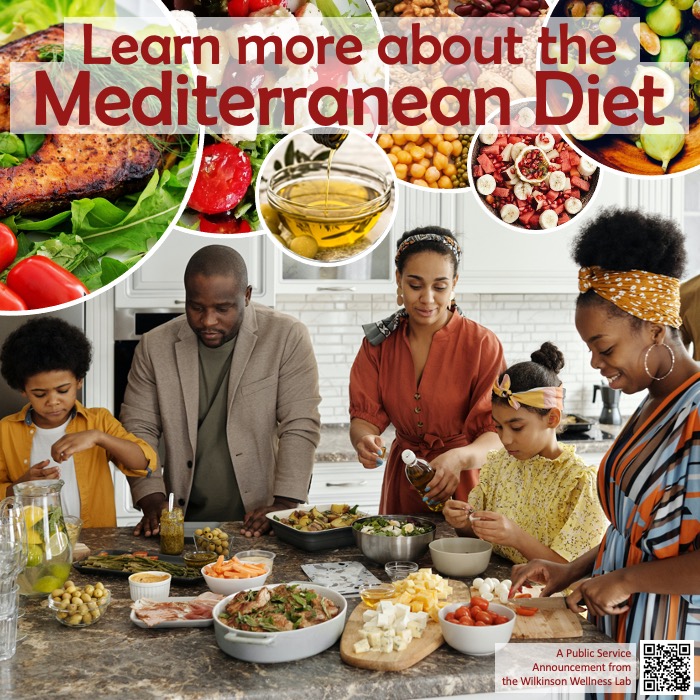
If you’ve ever spent time looking for healthy diets to follow, but wanted to avoid a highly restrictive diet (like vegan) or a commercial diet plan (like Weight Watchers), you probably have come across the Mediterranean Diet. It has been the subject of research for over 50 years and has been ranked the best overall diet by the U.S. News and World Report for four years running. The American Heart Association, the American Diabetes Association, the U.S. Department of Health and Human Services, the U.S. Department of Agriculture, and the World Health Organization have all endorsed the Mediterranean diet as a healthy and sustainable eating style that reduces risk for heart disease and Type 2 Diabetes. The Mediterranean Diet also may assist with weight loss in obese people and is associated with lower rates of depression, cognitive decline, cancer, and all-cause mortality.
This diet has a lot of major endorsements! So then, what’s up with this diet and why is it so special?
The Mediterranean Sea is a meeting point of three continents: Africa, Asia, and Europe. When health experts and researchers recommend the “Mediterranean Diet” they’re not talking about the food of just one people or one culture, but the common shared characteristics of the simple everyday meals made for centuries in this region of the world. Meals are built around plant-based foods, heavily seasoned with herbs and spice (though not tons of salt). These meals are made, shared, and enjoyed amongst a community of families and friends.
Here’s are the common characteristics of the Mediterranean Diet:
High consumption of vegetables, often raw or slightly cooked
Beans, nuts, legumes, seeds, potatoes, and unprocessed or whole grains
Olive oil as the principal source of fat
Fruit treated as a dessert
Moderate consumptions of fish, poultry, and dairy (mostly in the form of yogurt and cheese)
Low consumption of red meat
Moderate alcohol consumption, often in the form of red wine
Please check out the source below to learn more about the Mediterranean Diet. Please also share your thoughts about the Mediterranean Diet in the comments section of this post or via our page on Facebook @WilkinsonWellnessLab.
FLYER FROM EAST LAKE LIBRARY OF THE BIRMINGHAM PUBLIC LIBRARY SYSTEM
“What is missing is fun. We need to unplug and do something fun! It may sound cheesy, but having fun is self-care.” – Khalia Wilkinson
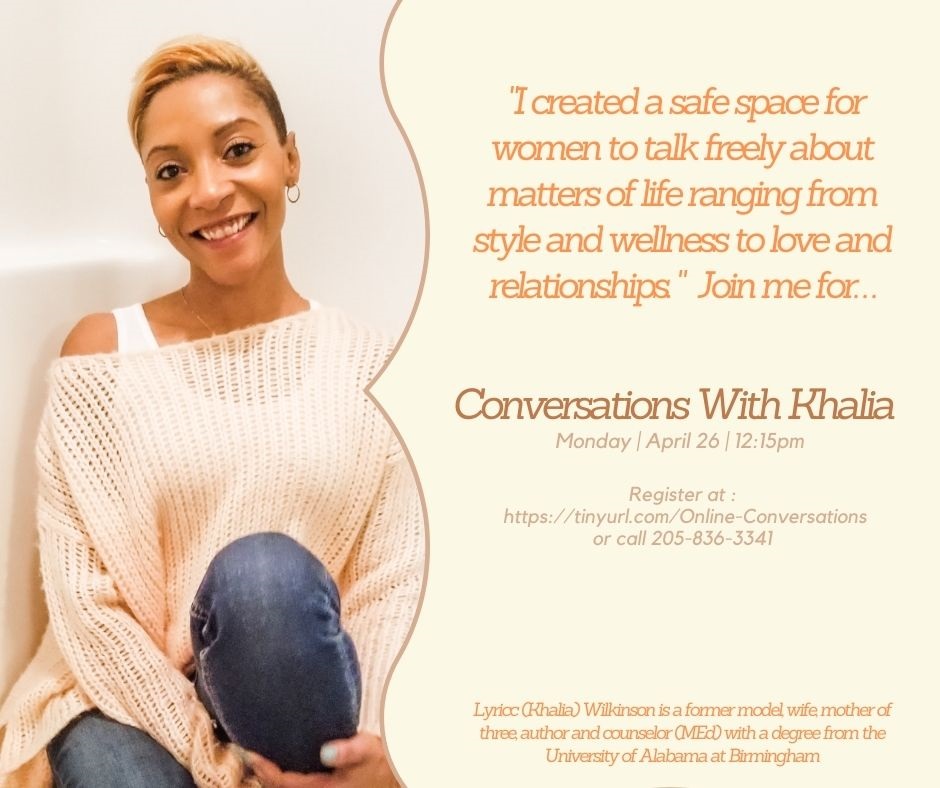
Are you ready to live well, be healthy, and walk into abundant life? Conversations with Khalia is a platform designed for women to speak freely about matters of life. Conversations with Khalia is a virtual talk on women’s wellness hosted through the East Lake Branch of the Birmingham Library every fourth Monday of the month. Mrs. Khalia Wilkinson is a coach and minister working with women looking to ditch feeling stressed, overwhelmed, drained, and desiring to be accomplished, healthy, and thriving. On April 26, 2021, she will host an online conversation at 12:15PM CST. You can register here (https://tinyurl.com/Online-Conversations) or call (205) 836-3341 to attend.
Khalia Wilkinson is a counselor and wellness coach with 15 years of experience mentoring and training women. She has written The Women’s COVID-19 Survival Guide to uplift women experiencing wellness withdrawals due to the sudden shifts in their schedules caused by the COVID-19 pandemic. The guide discusses in-depth how to navigate the required activities of daily living in this new unforeseen space while managing isolation, mental wellness, schedules, and self-care. She also hosts the Woman31 Podcast, a podcast rooted in biblical principles found in Proverbs, Chapter 31 with an accompanying website: Woman31.
Khalia believes that a woman’s health and well-being is foundational to ensuring all other scheduled family activities are successfully completed. The Women’s COVID-19 Survival Guide embraces concepts of self-care in support of one’s overall health and wellness. The guide offers easy-to-perform tasks that can help individuals better manage their well-being.
Self-care is typically visualized as a spa day. However, Khalia suggests that adequate sleep, eating a healthy and satisfying meal, praying, laughing at a good movie, and/or speaking with a trusted and supportive friend are all excellent modes of self-care. Understanding where you are and what health areas you need to focus on is pivotal to living well.
Khalia says that mental health is vital to overall wellness. She suggested that seeking professional counseling is absolutely a “good thing” to do, especially when one is experiencing serious mental illness. She also mentioned that feeling negative emotions is a signal to our body that something is not “okay.” Thus, it is important to listen to our body and seek help. When asked if there was any wellness advice she could offer, she said, “Do something fun and find ways to get back to the activities we love, because it can be healthy for our bodies.” You can always connect with Mrs. Khalia Wilkinson on Instagram, @khalia.woman31.






 Wilkinson Wellness Laboratory