By Jaelyn Copeland (Community Health and Human Services Student)
A vaccine is like a seatbelt. It’s a safety precaution that can save your life. Consider the COVID-19 vaccine. Talk to your doctor if you have questions or concerns.
The vaccine is like a seatbelt. Safe, effective, and well-tested. If you crash, you’ll be glad you have it. Strongly consider the vaccine. Talk to your doctor if you have questions or concerns.
Many activities that you enjoyed before the pandemic can be resumed once you are completely vaccinated. You are not considered fully immunized until two weeks after receiving your second dose of the Pfizer-BioNTech or Moderna COVID-19 vaccine, or two weeks after receiving a single dose of Johnson & Johnson’s Janssen COVID-19 vaccine. Until then, you should continue to use all available techniques to protect yourself and others, such as wearing a mask and practicing social distancing.
No vaccine is perfect, just as no helmet, seatbelt, or other safety device can guarantee you won’t get hurt. However, studies have demonstrated that vaccination provides a significant boost in protection and may make illness less severe for those who are still get sick. In Alabama, 97% of hospitalized COVID patients are unvaccinated. There is still a lot to learn about COVID-19 vaccinations; scientist and doctors are regularly assessing research and revising guidelines.
Vaccinate yourself, even if you’ve already had COVID-19. Reach out to your friends and loved ones to make sure they’re protected as well. The vaccine is currently available to everyone age 18 and older.
By Shayna Bryan, Intern & UAB Community Health & Human Services Student
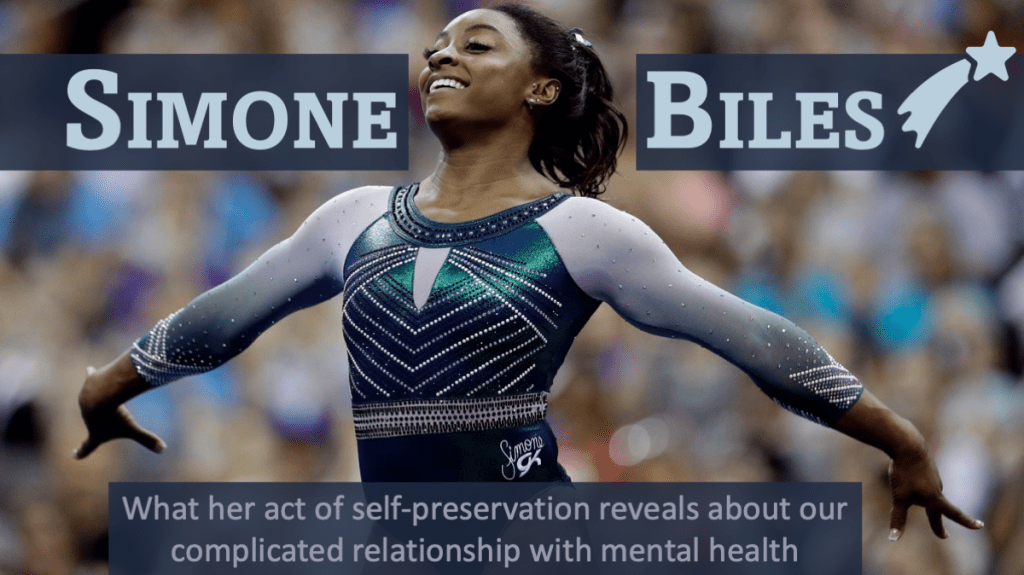
Original Photo by Charlie Riedel/AP
Simone Biles is an American gymnast with a combined total of 30 Olympic and World Championship medals. She is widely regarded by many as the greatest gymnast of our generation. Biles was the favorite to win multiple individual and team events in the 2020 Tokyo Olympics, but shocked the public when it was announced on July 27th that she would be pulling out of the final team competition for undisclosed health reasons. The following day, she pulled out of the rest of her planned events and gave further explanation: She’d been struggling with the immense pressure that comes with her position and could not compete due to physical and mental health issues. With Biles out of the competition, America’s chances of sweeping the gold for Olympic gymnastics all but vanished. This announcement was met with reactions of anger, outrage, betrayal, sympathy, and support. Why the mixed response?
If Biles had broken a bone or torn a ligament that rendered her unable to compete, the American public may have universally replied with kindness and empathy, viewing it as a tragedy. But because Biles’ reasons were partially mental, the feedback was not at all kind. Why such anger? The answer lies in our complicated and at times antagonistic relationship with mental health.
The World Health Organization describes mental health as “the foundation for the well-being and effective functioning of individuals.” According to the National Alliance on Mental Illness, 1 in 5 American adults have a mental illness, but less than half of those will receive treatment. This is likely due to the great stigma associated with mental health treatment and the common perception that seeking help is a last resort. As a result, the average delay between onset of symptoms and treatment is 11 years.
This is not at all how we treat physical issues, where prevention and prompt treatment are the norm. There is pressure to keep issues related to mental health invisible. Tough it out. This is especially a common thought among the athletic community.
The whole situation reminded me of a conversation I had about a month ago with Susan Chambers, a friend of mine who competes nationally in powerlifting. She was struggling with her own stubbornness in knowing when to quit and call it a day. When she’s tired and can’t focus, she’s at risk for serious injury which has happened to her in the past. On this day, she asked herself aloud, “Are you actually worried that will happen or are you being lazy and looking for an excuse? What’s the line between self-destructive and dedicated?”
I responded: “Guilt and shame.” If you’re pushing yourself because you feel inspired, all is good, but if guilt, shame, or fear of failure is motivating you, that’s bad. That’s when you risk seriously hurting yourself, mentally and physically.
Sue was silent for a moment, then said, “You win this round of self-care.”
Simone Biles is a gifted athlete who inspires many and will for years to come. She has the grit and determination to become a champion and the deep maturity to know herself and her limits. No matter the full circumstances, Simon Biles does not owe us further details or explanations. She does not need to justify her decision or apologize for the disappointment it caused, because she owes us nothing. She may be our pride and joy, but she belongs only to herself.
I reached out to Sue again for her thoughts on Simone Biles and the public response. She had this to say:
“Knowing your limits and prioritizing your health and well-being is laudable. Simone Biles is a world class athlete under an incomprehensible amount of scrutiny from the public. For her to advocate for herself and her needs was extraordinarily brave. We need more role models like her, who will demonstrate self-compassion as something more valuable than competition. I guess the short form is: She is a champion, and championing her own well-being proves it.”
Chambers, S. (2021, June 29). Personal communication [online chat].
Chambers, S. (2021, July 29). Personal communication [online chat].
Choudhry, F. R., Mani, V., Ming, L. C., & Khan, T. M. (2016). Beliefs and perception about mental health issues: a meta-synthesis. Neuropsychiatric disease and treatment, 12, 2807–2818. https://doi.org/10.2147/NDT.S111543
Riedel, C. (10 August 2019). Photograph of Simone Biles at US Championships. Associated Press.
@USAGym. “After further medical evaluation, Simone Biles has withdrawn from the final individual all-around competition. We wholeheartedly support Simone’s decision and applaud her bravery in prioritizing her well-being. Her courage shows, yet again, why she is a role model for so many.” Twitter, 28 Jul. 2021, 1:14 a.m., twitter.com/USAGym/status/1420266286441922562
by Shayna Bryan, Intern & UAB Community Health & Human Services Student
DASH Diet, Heart Healthy
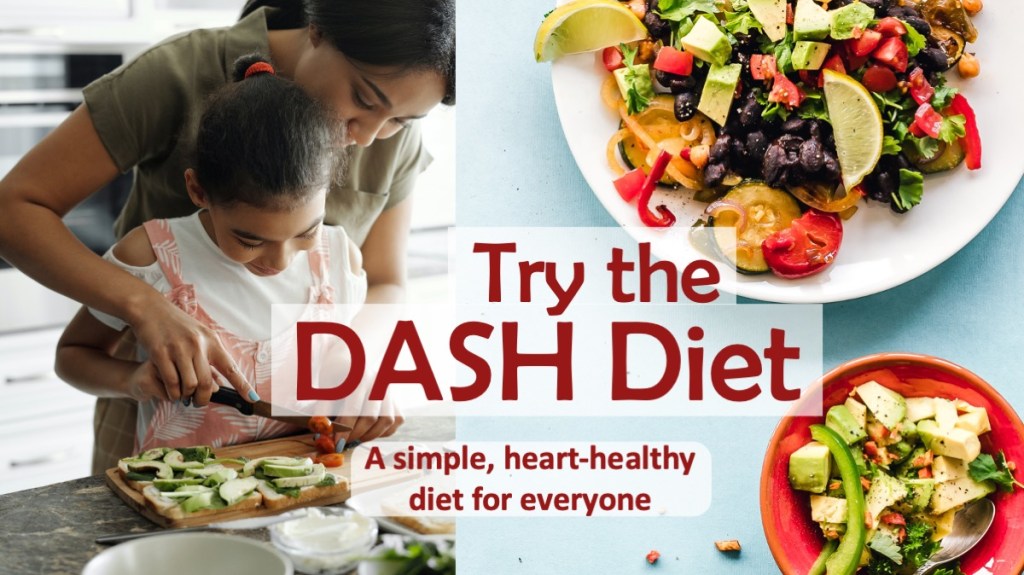
Heart disease is the number one cause of death in America. In addressing this national challenge, researchers created the DASH diet after following participants in a rigorous 5-year intervention called the Dietary Approaches to Stop Hypertension (DASH) Study. Hypertension, also known as high-blood pressure, is a major risk factor for heart disease, but can be managed with a healthy diet. The DASH diet was designed to be a nutrition-based approach to address the high rates of hypertension and heart disease associated with the typical high-sodium American diet. Most studies on nutrition use dietary recalls, looking at past diet history. In contrast, the DASH study participants were provided with food and their sodium intake was carefully controlled and monitored. The results of the DASH Diet Study demonstrated that diet alone is effective at reducing blood pressure!
The CDC recommends the average adult consumes less than 2,300 mg sodium per day. The DASH diet sets this as the beginning maximum, but about 90% of Americans are consuming far more than this. The average sodium consumption per day is an astounding 3,400 mg for U.S. adults! Just lowering one’s daily salt intake down to the CDC recommendation will be a major improvement for most people and will result in blood pressure reduction in a matter of weeks. The even more ambitious low-sodium DASH diet aims to gradually reduce your intake to 1,500 mg per day.
Most of the sodium we consume comes in the form of salt, which is added to processed foods for preservation and flavor. We can drastically lower our salt intake by focusing on whole foods which are naturally low in sodium.
The DASH diet emphasis the consumption of:
Fruits
Veggies
Whole grains
Lean protein
Low-Fat dairy
This combination is high in potassium, magnesium and calcium, and fiber, while low in saturated fats. All of these nutrients, particularly the potassium (which is abundant in vegetables) help naturally lower blood pressure and counteract the effects of excessive sodium. The DASH Diet also discourages foods high in saturated fat, such as red meat, as well as sugary beverages.
The DASH Diet is recommended by the American Heart Association and is ranked the best heart-healthy diet and second-best diet overall (it has often traded places with the very similar current #1 spot, the Mediterranean Diet, which you can read about here) by the U.S. News and World Report.
Gradual change is the key to success whenever making a positive change in life.
Here are some small changes you can make to ease yourself into DASH-style diet:
Add one serving of vegetables to your existing meals
Go meatless for 2+ days a week
Switch out some of your grains to whole, such as brown rice or whole wheat pasta
Add more herbs and spices to your meals, instead of salt
Snack on more whole foods, such as nuts or fruit
Below are some full meal plans designed by experts and more detailed resources.
“You cannot always control what goes on outside. But you can always control what goes on inside.” – Wayne Dyer
Regular meditation can help you to control your emotions, enhance your focus, and decrease stress. There are many different ways to mediate. The following steps can help get you started.
Step By Step Guide to Meditation
Choose a quiet, peaceful environment free from distractions
Wear comfortable clothes
Decide how long you want to meditate, 15-45 minutes is recommended
Sit in a comfortable upright position with your spine straightened
Close your eyes if it helps you to focus and relax
Follow your breathing
Breathe deeply, inhale through your nose then exhale through your mouth
Focus on your breathing and breathing only
Let all thoughts slide away and empty your mind, focus only on your breathing
Become aware of the rising and falling of your abdomen as you breathe in and out
Continue like this until your time is up.
Meditation takes practice. Don’t worry if you have trouble emptying your mind or become frustrated or easily distracted, just return to following your breathing. As you train your mind and body to relax through meditation, you’ll become accustomed to the routine and begin to associate deep breathing with stress relief. In the same way that pictures of food may make us feel hungry, meditative breathing can decrease our stress.
So, if you’re having a bad day and feeling under pressure, stop for just a moment to take a few deep breaths. The results may surprise you.
by Taylor Sullivan, M. Ed. | UAB Community Health & Human Services Alumni
July is Dry Eye Awareness Month
Dry eye is caused when the eyes do not make enough tears to stay moisturized or when the tears do not work correctly. Dry eyes can make your eyes feel uncomfortable and, in some cases, cause vision problems.
Dry eye is common and affects millions of Americans. There are several options available to help with dry eye while keeping eyes healthy and comfortable.
Symptoms of Dry Eye
Scratchy feeling as if something is in your eye
Stinging or burning feeling in your eye
Eye redness
Sensitivity to light
Blurry vision
Risks of Dry Eye
Anyone can get dry eye, but some are more at risk than others.
Those 50 years of age and older
Women
Contact lens wearers
Lack of Vitamin A
Certain autoimmune conditions
Too much screen time
Treatment depends on what causes your symptoms. Artificial tears are the most common treatment for mild dry eye. For severe dry eye, prescription medication may be necessary, but moisturizing gels and ointments are also available without a prescription.
Talk to your eye doctor today about dry eye and treatment and prevention options.
Brief Description: The human immune system becomes less effective at tackling infection or inflammation and less responsive to vaccinations as we age. This increases the risk of all age-related sickness. Fortunately, regular exercise, maintaining a moderate weight, and adopting the right diet may help a person maintain a healthy immune system throughout life and into old age.
Brief Description: For most older adults, good health ensures independence, security, and productivity as they age. Yet millions struggle every day with health and safety challenges such as chronic disease, falls, and mental health issues—all of which can severely impact quality of life. Get the facts on healthy aging and older adults: Chronic disease, falls, physical activity, oral health, and behavioral health are all topics older adults should learn about to ensure health and wellness as they age. The National Council on Aging Center for Healthy Aging provides chronic disease management, falls prevention, and other initiatives.
Title: What to Know Before Your Second COVID-19 Vaccines
Brief Description: Understand the do’s and don’ts of the two-dose coronavirus vaccination regimen. To be fully immunized, it’s critical to get that second shot. Your side effects will likely be stronger after the second dose. You should avoid taking pain relievers before your shot, but feel free to take them afterwards. The timing between doses does not need to be exact, though avoid getting the second dose too early; it can be given up to six weeks after the first. Your second dose should be from the same manufacturer as your first. A rash at the injection site is not a reason to skip your second dose. You should temporarily avoid all other vaccines. Full immunity is not immediate and won’t kick in till two weeks after your second dose. You still need to wear a mask as there is a small chance you could get sick or carry the virus and silently transmit it to others.
The COVID-19 pandemic may be stressful, but you can get through it. Take care of yourself and cope with the stress by addressing your physical, emotional, and mental health.
Take care of your Physical Health through
Eating a balanced diet
Regular physical activity
Plenty of good sleep
Avoiding excessive alcohol and drug use
Take care of your Emotional Health through
Connecting with others
Taking a break (unwinding)
Staying informed (but avoiding too much exposure to news)
Seeking help when you need it
Take care of your Mental Mealth through
Meditation
Connecting with your faith-based organization
Continuing with your treatment and staying aware of new or worsening symptoms
Calling for help if needed
Black Mental Health Resources
• National Suicide Prevention Lifeline (800) 273-8255
By Jaelyn Copeland (Community Health and Human Services Student), with contributions from Shayna Bryan (Intern & Community Health and Human Services Student)
Original photography by Mario Testino for Vogue magazine
Maternal mortality rates in the United States have been increasing steadily year after year, placing the country 56th on the World Health Organization’s worldwide data set, which is near the bottom of the developed nations. This disproportionately affects black women, who face not only the typical health hazards that come with childbirth, but must also wrestle with racial bias in the medical industry
Did you know black women are three times more likely to die due to pregnancy-linked causes than their peers?
According to the CDC, for every 100,000 births, 37 black women died in comparison to 15 white women and 12 Hispanic women. The causes of these racial differences are numerous. One of the issues is a lack of access to health care and poor quality of service. However, CDC data shows that even college-educated black women die at higher rates from pregnancy-related causes than white women who did not graduate from high school.
Look no further than Serena Williams, one of the greatest professional tennis players in history and an overall acclaimed athlete with a net worth over $200 million, whose pregnancy story demonstrates that these issues penetrate every level of society. In an interview with Vogue, Williams recalls battling with major problems shortly after the birth of her daughter. After her daughter was born through Cesarean section, Williams became short of breath. Knowing her own history of blood clots in the lungs (called pulmonary embolisms), she instantly alerted a nurse to her symptoms. However, staff were slow to respond to her concerns. The resulting complications ended in Williams needing a filter inserted into one of her major veins. It took six weeks of bed rest before she eventually returned home.
Serena’s traumatic story places her among the 50,000 women in America who face dangerous or life-threatening pregnancy-related problems each year.
However, researchers suggest this estimate may still be too conservative. Racial bias in the medical industry is a systemic issue that is becoming more recognized. The CDC has launched the Hear Her campaign to spread awareness and education on the complications associated with pregnancy. The lesson for the medical industry is to listen to patients more and make sure their needs are addressed. For the rest of us, the lesson is to learn to be your own best advocate.
Here are steps you can take:
Enroll in pre-natal care early, 1 month before pregnancy if possible
Take pre-natal vitamins as early as possible, even before becoming pregnant
Vitamins like folate are essential to brain and spinal cord development which occurs during the first few weeks of pregnancy
Learn the warning signs of common complications, particularly those you are at high risk for and those in your family medical history
Testino, M. (September 2017). Photograph of Serena Williams. Vogue.
WHO, UNICEF, UNFPA, World Bank Group, and United Nations Population Division Trends in Maternal Mortality: 2000 to 2017 Geneva: World Health Organization, 2019. Retrieved from: https://data.worldbank.
A good night’s sleep should not be taken for granted. Not getting enough sleep is linked to increased risk for type 2 diabetes, heart disease, stroke, obesity, and depression. Exhaustion can also lead to vehicular accidents and mistakes at work.
Sufficient sleep is an essential component of a healthy lifestyle. It is recommended that most adults sleep 7-9 hours each night for optimal health. It is also important that your regular sleep is of good quality, so you feel rested when you wake.
Getting enough sleeps means less sickness, a healthy weight, lower health risks for serious health conditions, reduced stress, improved mood, clearer thinking, and better decision making.
Talk to your doctor if you often have trouble sleeping or still feel tired after sleeping as these are symptoms of a possible sleep disorder.
Good Sleep Habits
Go to bed at the same time and wake up at the same time, even on the weekends
Make sure your bedroom is quiet, dark, relaxing, and at a comfortable temperature
Remove electronic devices from the bedroom (i.e. TVs, computers, cell-phones)
Avoid large meals, caffeine, and alcohol before bedtime
Enjoy some physical activity before bedtime
Are you getting enough sleep?
Take the Sleep Hygiene Index below to see if you are getting enough sleep. Answer the following thirteen (13) questions. If after adding your total below, your score is 7 and above, consider trying the good sleep habits above.
I take daytime naps lasting 2 or more hours (Yes or No)
I go to bed at different times from day to day (Yes or No)
I get out of be at different times from day to day (Yes or No)
I exercise to the point of sweating within 1 hour of going to bed (Yes or No)
I stay in bed longer than I should 2 or 3 times a week (Yes or No)
I use alcohol, tobacco, or caffeine within 4 hours of going to bed (Yes or No)
I do something that may wake me up before bedtime (play video games, browse internet, clean) (Yes or No)
I go to bed feeling stressed, angry, upset, or nervous (Yes or No)
I use my bed for things other than sleep or sex (watching TV, reading, eating, studying) (Yes or No)
I sleep on an uncomfortable bed (poor mattress or pillow, too much or not enough blankets) (Yes or No)
I sleep in an uncomfortable bedroom (too bright, too stuffy, too hot, too cold, too noisy) (Yes or No)
I do important work before bedtime (pay bills, study) (Yes or No)
I think, plan, or worry when I am in bed (Yes or No)
Score
For every Yes add 1 point, for every No add 0 points. Add up your totals.
0-3 Very Good
4-6 Good
7-9 Poor
10-13 Very Poor
(Sleep Hygiene Index Adapted from Mastin, Bryson & Corwyn, 2006)
Please check out the sources below to learn more about the practicing good sleep habits. Please also share your thoughts about sleep and sleep hygiene in the comments section of this post or via our page on Facebook @WilkinsonWellnessLab.
By Jerrica Lake, Intern & UAB Community Health & Human Services Student
Looking for a safe place to get a dose of sunshine this summer? Try Railroad Park, located in the heart of Birmingham and situated along 1st Avenue South between 14th and 18th Streets. The park is open 7 a.m.-11 p.m. daily with around-the-clock rangers on patrol and 24-hour security system surveillance. Free parking is available along the outer perimeters of the park along 1st Avenue South.
Get Active in the Park!
Featuring 19 acres of green space, including 9 acres of open lawn, Railroad Park is the ideal place to have a picnic, go for a jog, or play frisbee with peers or pets. There are onsite restrooms, water fountains, and a café with a delicious menu, so feel free to make a day of it!
Railroad Park is abundant with greenery and water features, with ponds, streams, an eye-catching lake, and a stunning rain curtain feature. More than 600 trees have been planted for shade and the abundance of flowers make the park a luxurious landscape for the senses.
There is large outdoor gym area inspired by Muscle Beach in California. For kids, the park offers two playgrounds and a climbing dome. For skaters, there is a designated skate zone with three skate bowls available. For an adult looking to get active, it offers a variety of walking trails including
The Magic City Loop (3/4 mile)
Rail Trail (1/3 mile)
Powell Avenue Promenade (1/3 mile)
Limestone Trace (1/2 mile)
With sweeping lawns, picturesque streams and the beautiful Birmingham skyline framing it all, Railroad Park a prime spot for relaxing and connecting with nature within our urban jungle.
Use this image to share the message on social media!









 Wilkinson Wellness Laboratory