6. The Role of Community Support in Preventing Unwanted Pregnancy in Alabama

Introduction

Teen pregnancy is not just an individual issue—it’s a community issue. In Alabama, communities play a crucial role in either preventing or exacerbating unwanted pregnancies. Whether through educational programs, local organizations, or supportive family structures, the environment around young people can either offer the support they need to make healthy choices or perpetuate the cycle of teen pregnancy.

The Importance of Community Support

In many parts of Alabama, where economic hardship and limited healthcare access are widespread, community resources can make a significant difference in the lives of young people. Research shows that when teens are connected to supportive mentors, access to health services, and educational opportunities, the likelihood of unwanted pregnancy decreases. Communities that foster open conversations about sexual health and provide resources for contraception and prenatal care are better equipped to combat teen pregnancy.

For example, according to the National Campaign to Prevent Teen and Unplanned Pregnancy, communities that promote positive youth development programs, including mentorship and life skills training, have lower teen pregnancy rates (National Campaign, 2023).

Types of Community Support That Can Help

  1. Education Programs
    • Local schools, nonprofits, and faith-based organizations can play a significant role in providing comprehensive sex education that goes beyond abstinence and covers birth control, healthy relationships, and consent.
    • Programs that teach financial literacy, job skills, and college preparedness can also reduce the likelihood of teen pregnancy by empowering young people to make informed decisions about their future.
  2. Mentorship and Peer Support
    • Having a mentor or role model can make a world of difference for a teen. Mentorship programs provide guidance, emotional support, and encouragement that teens may not receive at home.
    • Peer support groups for teens facing similar struggles, such as teen pregnancy, offer a safe space to share experiences and advice without judgment.
  3. Access to Healthcare and Family Planning Services
    • Local clinics, health centers, and community organizations must offer affordable and accessible contraception, sexual health screenings, and counseling services.
    • Expanding outreach programs that target underserved areas and provide confidential services to teens who may not have access to transportation or healthcare is critical.
  4. Engagement of Parents and Caregivers
    • Involving parents in their children’s education, especially when it comes to reproductive health, helps build a supportive foundation for decision-making. Schools and organizations can offer workshops to educate parents on how to talk to their children about sex, relationships, and contraception.

How Alabama Can Build Stronger Community Support Networks

  1. Partnerships Between Schools and Local Organizations
    • Schools should partner with community organizations to provide after-school programs focused on life skills, reproductive health education, and career readiness. This partnership can ensure that teens receive a well-rounded education that extends beyond the classroom.
  2. Strengthening Youth Development Programs
    • Investing in youth development programs that focus on building self-esteem, leadership skills, and resilience can reduce the risk of unintended pregnancy. Programs should be tailored to the unique needs of Alabama’s diverse communities.
  3. Promoting Family-Based Support
    • Strengthening the family unit through parenting programs, family counseling, and open communication can prevent unintended pregnancies. Families can play a role in providing emotional and financial support during a young person’s decision-making process.
  4. Expanding Community Health Initiatives
    • Community health centers should collaborate with local governments to increase the availability of affordable contraception and reproductive health services. Outreach initiatives to educate teens on the importance of contraception and sexual health should be prioritized.

Conclusion

The fight against unwanted pregnancy in Alabama requires more than just state policies—it requires a collective effort from communities, schools, healthcare providers, and families. By fostering a culture of support, education, and access to healthcare, we can reduce the teen pregnancy rate and provide young people with the tools they need to make healthy, informed choices.

References

  • National Campaign to Prevent Teen and Unplanned Pregnancy. (2023). Community support and teen pregnancy prevention. Retrieved from www.powertodecide.org
  • Power to Decide. (2023). Youth development and teen pregnancy prevention. Retrieved from www.powertodecide.org

5. The Silent Struggle: Mental Health and Unwanted Pregnancy Among Alabama’s Teen Girls

Introduction

When we talk about teen pregnancy, we often focus on the physical and financial burdens—but what about the emotional toll? Unwanted pregnancy can be overwhelming for any young person, leading to feelings of fear, anxiety, depression, and isolation. In Alabama, where reproductive health resources and mental health services are limited, many young mothers struggle in silence, unsure of where to turn.

I know that feeling all too well. At 17, I was pregnant and in complete denial. I convinced myself it wasn’t real, and by the time I accepted the truth, I was already about to give birth. The emotional weight of it all hit me hard. I felt alone, ashamed, and scared of what my future would look like. The stigma surrounding teen pregnancy made it even harder to ask for help. But the reality is, no one should have to go through this alone.

The Link Between Unwanted Pregnancy and Mental Health

Research shows that teen mothers are at a higher risk of experiencing mental health disorders. According to a study published in the Journal of Adolescent Health, pregnant teens are more likely to suffer from depression and anxiety than their non-pregnant peers (Journal of Adolescent Health, 2023). Factors contributing to this include:

  • Social stigma and judgment – Many young mothers face harsh criticism from their families, peers, and communities.
  • Emotional distress and regret – The sudden shift in life plans can trigger depression and feelings of hopelessness.
  • Lack of support systems – Without emotional or financial support, teen moms often feel abandoned and overwhelmed.
  • Postpartum depression – The hormonal changes following childbirth can contribute to mood swings, anxiety, and severe depression.

Barriers to Mental Health Care in Alabama

Alabama ranks among the worst states for mental healthcare access, especially for low-income and rural populations. Many young mothers do not have health insurance or the transportation needed to attend therapy appointments. Additionally, the stigma surrounding mental health prevents many teens from seeking help. According to the Kaiser Family Foundation, nearly 60% of teens experiencing depression in the U.S. do not receive treatment (KFF, 2023).

For young mothers, untreated mental health issues can lead to long-term consequences, such as difficulty bonding with their child, substance abuse, and even suicidal thoughts. The pressure of raising a baby while dealing with internal struggles can feel unbearable, yet so many teens suffer in silence because they believe they have no options.

How Can We Support the Mental Health of Teen Mothers?

  1. Expanding Access to Therapy and Counseling – Schools and community health centers should offer free, confidential counseling for pregnant teens.
  2. Reducing Stigma Through Education – Normalizing conversations about teen pregnancy and mental health can encourage young mothers to seek help.
  3. Creating Peer Support Networks – Support groups for teen mothers can provide emotional encouragement and reduce feelings of isolation.
  4. Integrating Mental Health into Prenatal and Postpartum Care – Every pregnant teen should have access to mental health screenings and resources.

Conclusion

The emotional impact of unwanted pregnancy is just as significant as the physical and financial burdens. As someone who has experienced the fear and uncertainty of being a pregnant teenager, I know how important mental health support is. Alabama must do more to ensure that young mothers receive the care and understanding they deserve. By expanding access to therapy, reducing stigma, and providing safe spaces for teens to seek help, we can prevent unnecessary suffering and create better futures for both young mothers and their children.

References

  • Journal of Adolescent Health. (2023). The impact of pregnancy on adolescent mental health. Retrieved from www.jahonline.org
  • Kaiser Family Foundation. (2023). Teen mental health and access to care in the U.S. Retrieved from www.kff.org

4. How Lack of Access to Contraceptives Affects Teen Pregnancy in Alabama

Introduction

One of the primary drivers of unwanted pregnancy among teens in Alabama is the lack of access to contraceptives. Despite the proven effectiveness of birth control in reducing unintended pregnancies, many young people face significant barriers to obtaining contraception. Whether due to restrictive policies, stigma, or lack of education, the inability to access birth control leaves many teens vulnerable to unplanned pregnancies.

I know this firsthand. I became pregnant at 17, but I was in deep denial. I didn’t want to believe it was happening, and because of that, my family didn’t find out about my daughter until a day before I had her. Like many young women, I didn’t have enough education about birth control, and I certainly didn’t feel comfortable seeking it out. Looking back, I realize how crucial access to contraception and reproductive health education is for teens—especially in states like Alabama, where stigma and restrictive policies make it even harder for young people to get the resources they need.

Contraceptive Access: A Challenge for Alabama Teens

Alabama has restrictive laws regarding adolescent access to contraceptive services. While some clinics offer confidential family planning services, many teens are unaware of these options or fear parental judgment. According to the Guttmacher Institute, states with limited access to contraceptive care tend to have higher teen pregnancy rates (Guttmacher Institute, 2023).

Furthermore, funding cuts to reproductive health services have made it harder for young people, particularly in rural areas, to obtain birth control. Many counties in Alabama lack a Title X-funded clinic, which provides free or low-cost contraceptive services to teens and low-income individuals. Without these resources, many adolescents are left without effective pregnancy prevention methods.

The Role of Stigma and Misinformation

In many communities, discussing contraception remains taboo. Some schools and parents discourage discussions about birth control, reinforcing the false belief that providing contraceptive education encourages sexual activity. However, research from the American Academy of Pediatrics shows that comprehensive contraception education actually delays sexual activity and increases contraceptive use among teens (AAP, 2023).

Misinformation is another major issue. Many young people believe myths about birth control, such as the idea that it causes infertility or severe health risks. Without proper education, they may rely on ineffective methods, such as withdrawal or avoiding sex on certain days, which significantly increase the risk of pregnancy.

Potential Solutions: Expanding Contraceptive Access for Alabama Teens

To address these challenges, several measures can improve access to contraceptives in Alabama:

  1. Expanding School-Based Health Clinics – Schools can provide confidential access to birth control and counseling services, ensuring teens receive proper education.
  2. Allowing Over-the-Counter Birth Control – Making oral contraceptives available without a prescription can help eliminate barriers for teens who lack healthcare access.
  3. Increasing Funding for Title X Clinics – More funding for clinics that serve low-income teens can expand their reach and reduce unintended pregnancies.
  4. Comprehensive Sex Education – Schools should include medically accurate information about contraception in health curriculums.

Conclusion

The inability to access contraceptives is a significant factor contributing to Alabama’s high teen pregnancy rate. I know what it’s like to be a teenager facing an unexpected pregnancy with no real guidance or support. By expanding access, reducing stigma, and increasing education efforts, we can better equip young people with the knowledge and resources to prevent unwanted pregnancies. Effective contraception policies and community support can help teens take control of their reproductive health and future.

References

  • Guttmacher Institute. (2023). Contraceptive access and teen pregnancy rates in the U.S. Retrieved from www.guttmacher.org
  • American Academy of Pediatrics. (2023). The impact of contraception education on teen pregnancy. Retrieved from www.aap.org

3. How Lack of Access to Contraceptives Affects Teen Pregnancy in Alabama

Introduction

One of the primary drivers of unwanted pregnancy among teens in Alabama is the lack of access to contraceptives. Despite the proven effectiveness of birth control in reducing unintended pregnancies, many young people face significant barriers to obtaining contraception. Whether due to restrictive policies, stigma, or lack of education, the inability to access birth control leaves many teens vulnerable to unplanned pregnancies.

Contraceptive Access: A Challenge for Alabama Teens

Alabama has restrictive laws regarding adolescent access to contraceptive services. While some clinics offer confidential family planning services, many teens are unaware of these options or fear parental judgment. According to the Guttmacher Institute, states with limited access to contraceptive care tend to have higher teen pregnancy rates (Guttmacher Institute, 2023).

Furthermore, funding cuts to reproductive health services have made it harder for young people, particularly in rural areas, to obtain birth control. Many counties in Alabama lack a Title X-funded clinic, which provides free or low-cost contraceptive services to teens and low-income individuals. Without these resources, many adolescents are left without effective pregnancy prevention methods.

The Role of Stigma and Misinformation

In many communities, discussing contraception remains taboo. Some schools and parents discourage discussions about birth control, reinforcing the false belief that providing contraceptive education encourages sexual activity. However, research from the American Academy of Pediatrics shows that comprehensive contraception education actually delays sexual activity and increases contraceptive use among teens (AAP, 2023).

Misinformation is another major issue. Many young people believe myths about birth control, such as the idea that it causes infertility or severe health risks. Without proper education, they may rely on ineffective methods, such as withdrawal or avoiding sex on certain days, which significantly increase the risk of pregnancy.

Potential Solutions: Expanding Contraceptive Access for Alabama Teens

To address these challenges, several measures can improve access to contraceptives in Alabama:

  1. Expanding School-Based Health Clinics – Schools can provide confidential access to birth control and counseling services, ensuring teens receive proper education.
  2. Allowing Over-the-Counter Birth Control – Making oral contraceptives available without a prescription can help eliminate barriers for teens who lack healthcare access.
  3. Increasing Funding for Title X Clinics – More funding for clinics that serve low-income teens can expand their reach and reduce unintended pregnancies.
  4. Comprehensive Sex Education – Schools should include medically accurate information about contraception in health curriculums.

Conclusion

The inability to access contraceptives is a significant factor contributing to Alabama’s high teen pregnancy rate. By expanding access, reducing stigma, and increasing education efforts, the state can better equip young people with the knowledge and resources to prevent unwanted pregnancies. Effective contraception policies and community support can help teens take control of their reproductive health and future.

References

  • Guttmacher Institute. (2023). Contraceptive access and teen pregnancy rates in the U.S. Retrieved from www.guttmacher.org
  • American Academy of Pediatrics. (2023). The impact of contraception education on teen pregnancy. Retrieved from www.aap.org

2. The Role of Poverty and Education in Teen Pregnancy Rates in Alabama

Introduction

Teen pregnancy is a complex issue influenced by various social determinants, including poverty and education. In Alabama, where poverty rates are higher than the national average, young people face significant barriers to accessing healthcare, contraception, and quality education. These factors create an environment where unintended pregnancies among adolescents remain a persistent challenge. Addressing these issues requires an understanding of how poverty and education shape reproductive outcomes.

How Poverty Increases Teen Pregnancy Rates

Poverty plays a significant role in teenage pregnancy by limiting access to necessary resources. According to the U.S. Census Bureau, Alabama’s poverty rate is 15.5%, with many of the most affected communities located in rural areas (U.S. Census Bureau, 2023). Low-income teens are less likely to have health insurance, making it difficult to obtain birth control, emergency contraception, or counseling services.

In addition, financial instability can lead to risky behaviors. Some young people see pregnancy as a way to establish independence or gain financial support through social welfare programs. Others may lack parental guidance due to economic hardships, leading to greater exposure to peer pressure and early sexual activity. Research from the National Campaign to Prevent Teen and Unplanned Pregnancy suggests that financial insecurity is a predictor of higher teen birth rates (Power to Decide, 2023).

Educational Disparities and Their Impact on Teen Pregnancy

Education is one of the strongest protective factors against teen pregnancy. Teens who complete high school and pursue higher education are significantly less likely to experience unintended pregnancies. However, Alabama’s education system struggles with funding disparities, particularly in low-income districts. Schools in underprivileged areas often lack comprehensive sex education programs, leaving students uninformed about contraception and reproductive health.

A report from the Brookings Institution found that abstinence-only education, which is still common in Alabama, does not effectively reduce teen pregnancy rates. Instead, states that offer comprehensive sex education see lower rates of unintended pregnancies and STIs (Brookings Institution, 2023). Without access to medically accurate information, Alabama’s youth are at a greater risk of engaging in unsafe sexual behaviors.

Breaking the Cycle: Solutions and Policy Recommendations

To reduce teen pregnancy in Alabama, policy changes and community programs must address both poverty and education:

  • Expanding access to contraception through school-based health clinics and local health departments
  • Providing comprehensive sex education that includes information on contraception, healthy relationships, and decision-making
  • Offering mentorship and career programs to encourage young people to focus on long-term goals and financial stability
  • Increasing Medicaid coverage for teens to ensure they have access to reproductive healthcare

Conclusion

Teen pregnancy is not just a personal issue—it is a reflection of broader economic and educational disparities. Addressing the link between poverty, education, and reproductive health in Alabama is essential for giving young people better opportunities. By investing in education and access to healthcare, policymakers can help break the cycle of teen pregnancy and improve long-term outcomes for Alabama’s youth.

References

  • U.S. Census Bureau. (2023). Poverty in the United States: Alabama statistics. Retrieved from www.census.gov
  • Power to Decide. (2023). Teen pregnancy and economic opportunity. Retrieved from www.powertodecide.org

  • Brookings Institution. (2023). The impact of education on teen pregnancy rates. Retrieved from www.brookings.edu

1.Understanding the Root Causes of Unwanted Pregnancy Among Alabama Teens.

Introduction

Teen pregnancy continues to be a pressing public health issue in Alabama, where young people between the ages of 13 and 21 face high rates of unintended pregnancy. Despite national declines, Alabama’s rates remain among the highest in the country. Understanding the root causes behind this issue is critical to implementing effective solutions that prevent early pregnancies and improve young people’s futures.

Social and Economic Factors Contributing to Teen Pregnancy

A significant factor influencing unwanted pregnancy in Alabama is poverty. Studies show that teens from low-income backgrounds are more likely to experience unintended pregnancies due to limited access to contraception, healthcare, and comprehensive sexual education (Guttmacher Institute, 2023). The financial burden on families often leads to early parenthood cycles, as young mothers struggle with economic instability, making it harder to break free from generational poverty.

Additionally, Alabama ranks among the lowest states for educational attainment, and there is a clear connection between education levels and pregnancy rates. Teen girls who do not complete high school are more likely to become pregnant than those who graduate (National Campaign to Prevent Teen and Unplanned Pregnancy, 2023).

Lack of Access to Sexual Education and Reproductive Health Services

One of the most debated contributors to unwanted pregnancy in Alabama is the state’s approach to sex education. Many schools follow abstinence-only programs, which have been shown to be ineffective in reducing teen pregnancy rates. According to the Centers for Disease Control and Prevention (CDC), states that mandate comprehensive sex education see lower rates of teen pregnancy compared to those that rely solely on abstinence-based curricula (CDC, 2023).

Furthermore, access to birth control and reproductive healthcare remains a challenge, particularly in rural areas. Many young people lack affordable options for contraception, and the stigma around seeking reproductive healthcare further discourages them from accessing necessary services (American Academy of Pediatrics, 2022).

The Role of Family Dynamics and Cultural Expectations

Family dynamics also play a critical role in influencing teen pregnancy rates. In many Alabama communities, open discussions about reproductive health are still considered taboo, leaving young people without guidance. Research suggests that teens who have strong parental support and open communication about sexual health are less likely to experience unintended pregnancies (Guttmacher Institute, 2023).

Religious and cultural beliefs also shape attitudes toward pregnancy. In conservative regions, some communities discourage contraception and instead emphasize marriage and motherhood at a young age, which can lead to higher pregnancy rates among teens (Pew Research Center, 2023).

Conclusion: Addressing the Root Causes of Unwanted Pregnancy

To effectively reduce unwanted pregnancy among Alabama teens, a multifaceted approach is needed. Expanding access to comprehensive sex education, increasing affordability and availability of contraception, and fostering open family communication can all contribute to lowering pregnancy rates. Additionally, policymakers and community organizations must work together to address the broader socioeconomic factors that place young people at risk. By tackling these root causes, Alabama can create a healthier future for its youth.

Credible Sources:

  • Guttmacher Institute. (2023). State Policies in Brief: An Overview of Abortion Laws. Retrieved from www.guttmacher.org
  • Centers for Disease Control and Prevention (CDC). (2023). Teen Pregnancy Prevention. Retrieved from www.cdc.gov
  • Pew Research Center. (2023). Religion and Public Life. Retrieved from www.pewresearch.org
  • National Campaign to Prevent Teen and Unplanned Pregnancy. (2023). Teen Pregnancy Data. Retrieved from www.powertodecide.org
  • American Academy of Pediatrics. (2022). Barriers to Adolescent Reproductive Health. Retrieved from www.aap.org

Feria de Salud Revive on Noviembre 2, 2024 at 10:00am – 2:00pm

En Espanola
El Laboratorio de Bienestar de Wilkinson se complace en asociarse con el Programa de Salud y Servicios Humanos Comunitarios de la UAB y la Iglesia Vida Cristiana en apoyo de la Feria de Salud Revive el sábado 7 de octubre de 2023. La feria de salud se llevará a cabo en 2490 Valleydale Road y se llevará a cabo de 9 a. m. a 1 p. m. Como recurso para la feria de salud, el Laboratorio de Bienestar de Wilkinson ofrece:

  • Detección de presión arterial,
  • Lectura del índice de masa corporal,
  • Lectura del porcentaje de grasa corporal y
  • Lectura del porcentaje de músculo esquelético

Para obtener más recursos que le ayuden a alcanzar sus objetivos de peso general, haga clic en los enlaces siguientes:

Alimentación saludable para adultos: https://www.myplate.gov/es/tip-sheet/alimentacion-saludable-para-adultos

Alimentación saludable para niños: https://eclkc.ohs.acf.hhs.gov/sites/default/files/pdf/healthy-eating-family-tips-esp.pdf

In English

The Wilkinson Wellness Lab is excited to partner with the UAB Community Health & Human Services Program and Christian Life Church in support of the Revive Health Fair on Saturday, October 7, 2023. The health fair is located at 2490 Valleydale Road and will take place 9am – 1pm. As a resource for the health fair, the Wilkinson Wellness Lab is providing:

  • Blood pressure screening,
  • Body Mass Index reading,
  • Body Fat percentage reading, and
  • Skeletal muscle percentage reading

For more resources in support of achieving your overall weight goals, please click on the links below:

Food

Physical Activity

Sleep

Body Mass Index

https://www.cdc.gov/healthyweight/assessing/bmi/adult_bmi/

Join the conversation on Facebook or in the comments section. Have you lost weight over a process? What did you do lose weight? How long did the weight loss take you? How was your experience? Please share with family and friends.


Restful sleep supports reduced stress. Let’s try it for ourselves

By the Wilkinson Wellness Lab

Are we trying to stay up so we can cram for the test? Perhaps we hung out too late and now we are feeling it in the morning. Maybe we drank to much Starbucks and we want to go to sleep, but just can’t. Or perhaps, we are a little worried about the paper that needs to be written and it is haunting us…no sleep. Either way, are sleep is impacted, which is still detrimental to our ability to cope with stress and support our mental health.

According to a study by Scott et al. (2021), improving sleep quality leads to better mental health. Other organizations like the Centers for Disease Control and Prevention (CDC) and the Sleep Foundation, also suggest the connection is relevant and asserts the connection to how we handle stress. Thusly, to improve mental health and stress management, it is a good idea to practice a sleep routine. A sleep routine is a a set of activities you do before bed each night to help you fall asleep. Some steps to include in creating your sleep routine may involve:

Setting a consistent sleep schedule: Go to bed and wake up at the same time every day, even on weekends to support your body’s rhythm.

Create a relaxing bedtime routine: Engage in calming activities before bed. Activities may include reading, warm baths, deep breathing exercises and meditation.

Create a calming sleep environment: Ensure your bedroom is cool, dark, and quiet. If needed, invest in an eye cover or ear plugs to limit noise and intrusions.

Limit exposure to screen: Reduce blue light exposure from phones, tablets, and computers at least an hour before bedtime.

Monitor your diet before bed: Avoid large meals, caffeine, and alcohol close to bedtime. These can disrupt your sleep cycle.

Be active during the day: Regular physical activity can help you fall asleep faster and enjoy deeper sleep. But try not to work-out close to bedtime.

Stress management: Techniques like placing your thoughts out of your head and elsewhere (i.e., journaling), yoga, and mindfulness can help reduce stress prior to your bedtime.

Have you tried these techniques above? If so, how did you do it? If not, what is hindering you from trying? Perhaps you tried, but when times became stressful, so stop working to solidify your routine. What next steps do you suggest? Please share your thoughts in the comment section and or visit us on Facebook @WilkinsonWellnessLab.


UAB Community Health & Human Services Program sponsors National Health Education Week 2024

Please join the UAB Community Health & Human Services (CHHS) Program at our mental health and wellness outreach table on Tuesday, October 22nd (10am – 1pm). We will have a few items in support of overall student health and well-being, while also equipping ourselves with mental wellness techniques to exercise through the remainder of the semester. Check us out in the Education & Engineering Complex (EEC). See the flyer below.

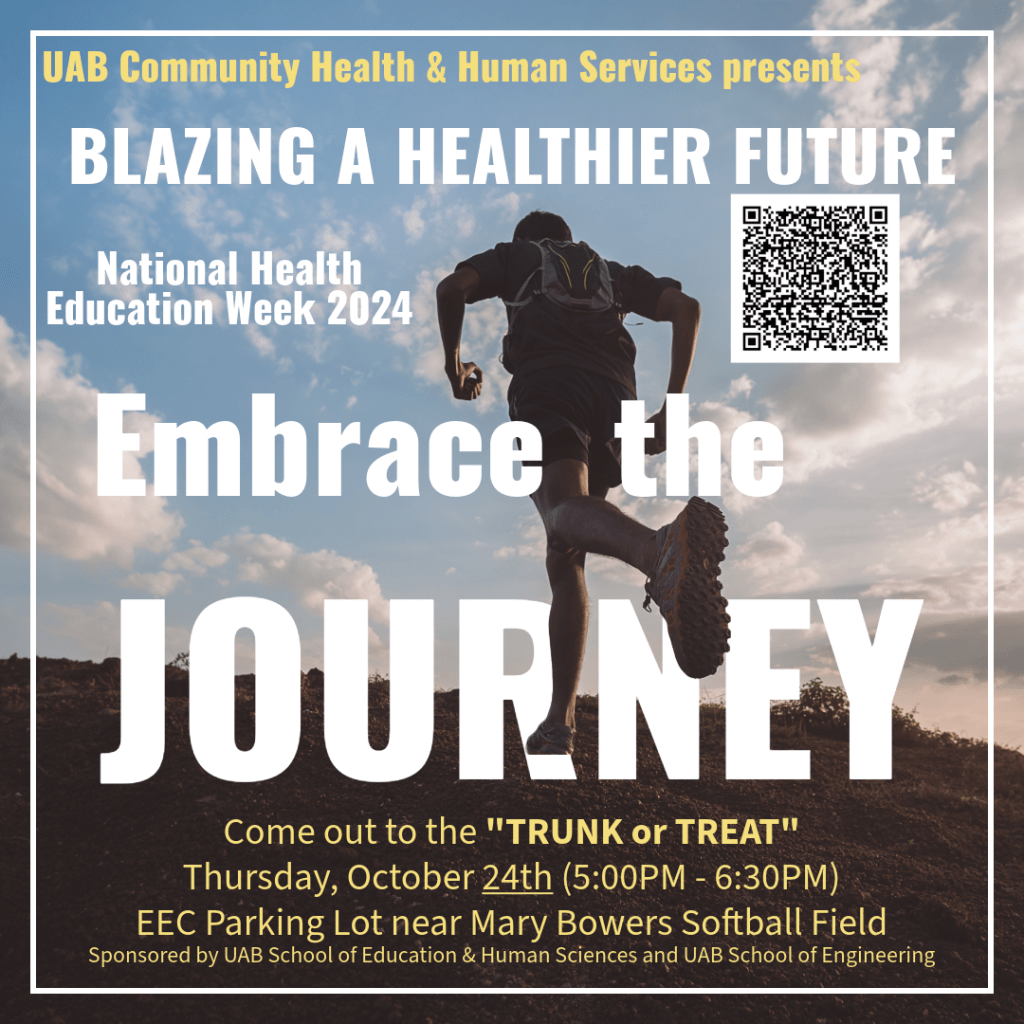
Please join the UAB Community Health & Human Services (CHHS) Program and have a good time ‘moving’ at the School of Education & Human Sciences “Trunk or Treat” event on Tuesday, October 24th (5:00pm – 6:30pm). The CHHS Program will provide the sounds that keep you ‘moving and grooving’ as you visit different trunks to get your treats. Come out and play corn hole, dance in streets, and get some candy. We will have a few items in support of overall student health and well-being. Check us out in the Education & Engineering Complex (EEC). See the flyer below.

Tips for Physical, Mental, & Emotional Well-Being

To learn more about National Health Education Week, please visit the Society for Public Health Education (SOPHE) website, here. To learn more about emotional wellness in the United States of America, please visit the Centers for Disease Control & Prevention (CDC) weblink, here. Regarding ones physical health, the CDC recommends the following, here.