Swollen Balls: Say It Ain’t So?

By Flora Johnson, M.Ed. | UAB Community Health & Human Services Alumni
Image from Alex Green | Graphics by Shayna Bryan

Question of the Day

A 23-year-old male is referred for treatment due to swollen testicles. He explains that the reaction occurred after receiving a COVID-19 vaccination. What is the best response?

  1. Laugh at the gentleman and dismiss his claim.
  2. Report on the condition to the local county health department immediately.
  3. Thank them for their honesty and let everyone know why not get vaccinated.
  4. Assure it is scientifically impossible and offer evidence-based reasons for testicle swelling.

Continue reading for the answer.


Vax Facts

A reasonable amount of blame has been placed upon the COVID-19 pandemic. Shoveling our woes on the virus is not uncommon. Sure, the virus has caused major and minor disruptions. However, the coronavirus vax jab facts remain the same – it is safe for medical use with little to no known major medical disruptions.

COMRINATY is the Pfizer-BioNTech vaccine approved by the Food and Drug Administration (FDA) for injection use in individuals age 16 and older. The known side effects are mild and include injection site pain, redness, and/or swelling. Chills, fever, headache, muscle pain, nausea, and tiredness are also side effects experienced throughout the body.

These side effects occur within two days. This is normal and will go away within a few days. It is 95% effective at preventing infection or death.

My cousin in Trinidad won’t get the vaccine cuz his friend got it & became impotent. His testicles became swollen. His friend was weeks away from getting married, now the girl called off the wedding. So just pray on it & make sure you’re comfortable with ur decision, not bullied.

-Nicki Minaj (@NICKIMINAJ)

The Thing Is

Recording artist, Grammy winner, and actress, Nicki Minaj stirred controversy for her vaccine hesitancy perception. The star explained that their Trinidadian cousin’s best friend’s testicles swelled after receiving a vax jab. He allegedly experienced impotence.

Whoa! Let’s fact-check this. The Messenger’s message has a resounding magnitude – one that matters.

Nicki was uninvited to the Met Gala for non-vaccination. She had unanswered COVID-19 questions and refused to take the shot. Her primary concern was valid. However, the controversy caused chaos in Trinidad and abroad. An opportunity to express her vaccine hesitancy concerns with Dr. Fauci, the Director of the National Institutes of Health (NIH) and leading COVID-19 physician advisor to the United States, during a live-streamed phone call resulted.

As we stand now, there is no reported such side effect or adverse event of testicular swelling in Trinidad, or I dare say… none that we know of anywhere else in the world.

Trinidad and Tobago Minister of Health, Terrence Deyalsingh

Question of the Day Answer

D. Assure it is scientifically impossible and offer evidence-based reasons for testicle swelling. There are no identified reproductive side effects. Possible reasoning for scrotal swelling is the following:

  • Trauma that causes inflammation
  • Testicular cancer
  • STIs (chlamydia, gonorrhea, and syphilis)

Take Away This

While the coronavirus vaccines were developed rapidly, they are safe. They reduce viral transmissions and can keep you from getting seriously ill if infected. All side effects are mild and are experienced at the injection site or throughout the body. The vaccine does not disturb the reproductive system.

If I want to ask questions about the vaccine, what’s wrong?”

– Nicki Minaj (@NICKIMINAJ)

There is absolutely nothing wrong with asking questions. However, be certain the information you find is credible. Click here to learn the vax jab facts and where to find other plausible wellness resources.

Use this image to share the message on social media!

Sources and Further Reading:

Centers for Disease Control and Prevention. (n.d.). Benefits of getting a COVID-19 vaccine. Centers for Disease Control and Prevention. Retrieved October 6, 2021, from https://www.cdc.gov/coronavirus/2019-ncov/vaccines/vaccine-benefits.html.

Centers for Disease Control and Prevention. (n.d.). Pfizer-biontech COVID-19 vaccine overview and Safety. Centers for Disease Control and Prevention. Retrieved October 6, 2021, from https://www.cdc.gov/coronavirus/2019-ncov/vaccines/different-vaccines/Pfizer-BioNTech.html.

Cohen, L. (2021, September 16). White House offers Nicki Minaj a call after she expressed COVID-19 vaccine hesitancy, official says. CBS News. Retrieved October 6, 2021, from https://www.cbsnews.com/news/nicki-minaj-white-house-call-covid-vaccine-hesitancy/.

Kahn, A., & Fisher, J. K. (2019, July 2). What you need to know about scrotal swelling. Healthline. Retrieved October 6, 2021, from https://www.healthline.com/health/scrotal-swelling#causes.

U.S. Department of Health and Human Services. (n.d.). Anthony S. Fauci, M.D., Niaid director. National Institute of Allergy and Infectious Diseases. Retrieved October 6, 2021, from https://www.niaid.nih.gov/about/director.
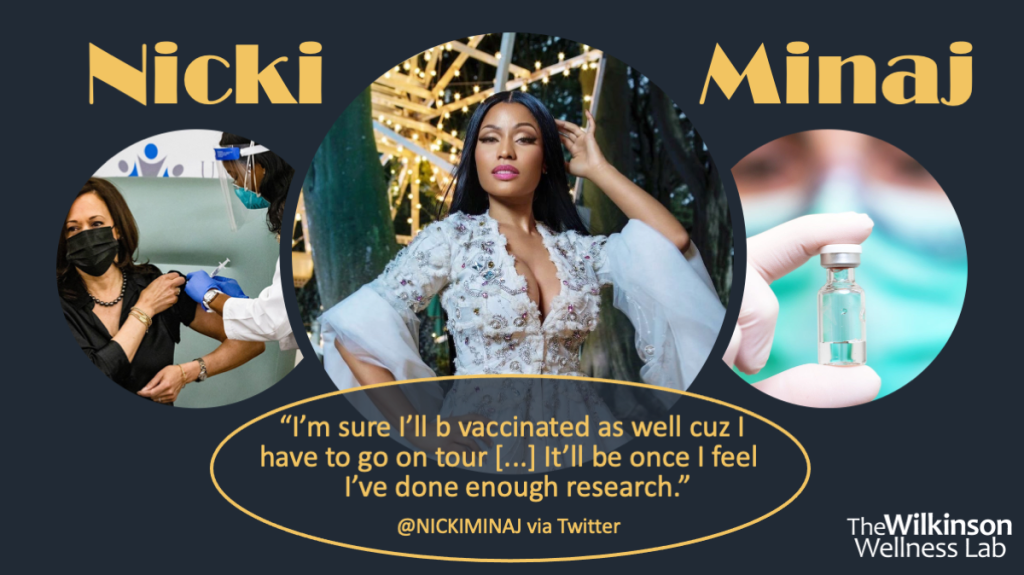

Where to Get Your Vax Facts & Good Health Information

 By Jaelyn Copeland, Intern and UAB Community Health and Human Services Student

Photos from @NICKIMINAJ on Twitter and Getty Images | Graphics by Shayna Bryan

Recently, the recording artist and global celebrity Nicki Minaj tweeted a series of statements expressing her reason for not attending the Met Gala, the star-studded fashion event postponed this year to September 13th due to COVID-19.  In tweets following, the artist went on to explain, “I’m sure I’ll b vaccinated as well cuz I have to go on tour,” Minaj wrote in a tweet about missing Monday’s Met Gala in New York, implying that she had yet to be vaccinated, which the gala requires. “Once I believe I’ve done enough research,” she continued, she’ll get vaccinated. 

Health educators encourage the general public to consider the facts regarding their health and well-being.  Health educators also work to promote healthy decision making based on the valid science that is available.  Understanding that there are many untrue myths regarding a wide array of topics on social media and in other spaces, health educators encourage of anyone wanting to do their own personal research concerning the vaccine (& other topics).   

To obtain appropriate sources of information, the Wilkinson Wellness Lab recommends visiting health websites supported by Federal Government entities. By going to http://www.usa.gov, you can access all Federal websites. Large professional organizations and well-known medical schools can also be excellent providers of health knowledge. 

Look for websites that end in:  

  • .gov – Identifies a U.S. government agency  
  • .edu - Identifies an educational institution, like a school, college, or university  
  • .org – Usually identifies nonprofit organizations (such as professional groups; scientific, medical, or research societies; advocacy groups)  
  • .com – Identifies commercial websites (such as businesses, pharmaceutical companies, and sometimes hospitals)  

Also, take into account the authors and contributors of the website or social media information as well. If the author’s name appears within the posting, consider whether or not that individual is an authority in the topic. Is this person employed by a company, and if yes, what are the company’s objectives?  Trustworthy websites will typically provide contact information (such as an email address, phone number, and/or mailing address), as well as an “About Us” or “Contact Us” page. 

These tips and more are great ways to examine if a resource is “truthful” or not and support your health decision making in balance with one’s faith.

For accurate information regarding the COVID-19 pandemic, please visit: https://www.cdc.gov/library/researchguides/2019novelcoronavirus/websites.html


Feel free to share this image via social media.

Sources and Further Reading:

Bryan Pietsch, A. S. (2021, September 14). Nicki Minaj Tweets Coronavirus vaccine conspiracy theory, spotlighting struggle against misinformation. The Washington Post. Retrieved September 14, 2021, from https://www.washingtonpost.com/arts-entertainment/2021/09/14/nicki-minaj-covid-19-vaccine-conspiracy/.   

Centers for Disease Control and Prevention. (n.d.). Centers for Disease control and Prevention. Centers for Disease Control and Prevention. Retrieved September 17, 2021, from https://www.cdc.gov/. 

U.S. Department of Health and Human Services. (n.d.). National institutes of health. National Institutes of Health. Retrieved September 17, 2021, from https://www.nih.gov/.   


Vaccinate for Safety

By Jaelyn Copeland (Community Health and Human Services Student)

A vaccine is like a seatbelt. It’s a safety precaution that can save your life. Consider the COVID-19 vaccine. Talk to your doctor if you have questions or concerns.

The vaccine is like a seatbelt. Safe, effective, and well-tested. If you crash, you’ll be glad you have it. Strongly consider the vaccine. Talk to your doctor if you have questions or concerns. 

Many activities that you enjoyed before the pandemic can be resumed once you are completely vaccinated. You are not considered fully immunized until two weeks after receiving your second dose of the Pfizer-BioNTech or Moderna COVID-19 vaccine, or two weeks after receiving a single dose of Johnson & Johnson’s Janssen COVID-19 vaccine. Until then, you should continue to use all available techniques to protect yourself and others, such as wearing a mask and practicing social distancing.

No vaccine is perfect, just as no helmet, seatbelt, or other safety device can guarantee you won’t get hurt. However, studies have demonstrated that vaccination provides a significant boost in protection and may make illness less severe for those who are still get sick. In Alabama, 97% of hospitalized COVID patients are unvaccinated. There is still a lot to learn about COVID-19 vaccinations; scientist and doctors are regularly assessing research and revising guidelines. 

Vaccinate yourself, even if you’ve already had COVID-19. Reach out to your friends and loved ones to make sure they’re protected as well. The vaccine is currently available to everyone age 18 and older.

To find a clinic to get vaccinated, visit Vaccines.gov or Alabama’s COVID-19 Dashboard


Sources and Further Reading:

Centers for Disease Control and Prevention. (2021, August 5). COVID-19 breakthrough Case investigations and reporting. Centers for Disease Control and Prevention. https://www.cdc.gov/vaccines/covid-19/health-departments/breakthrough-cases.html.

Jones, A. (2021, August 3). Back to square one: UAB experts say Social DISTANCING, Masks, vaccinations are key to STOPPING covid-19 surge. UAB News. https://www.uab.edu/news/health/item/12192-back-to-square-one-uab-experts-say-social-distancing-masks-vaccinations-are-key-to-stopping-covid-19-surge.

“When You’ve Been Fully Vaccinated.” Centers for Disease Control and Prevention, Centers for Disease Control and Prevention, http://www.cdc.gov/coronavirus/2019-ncov/vaccines/fully-vaccinated.html.


Let’s Be #VACCINEREADY for National Minority Health Month 2021

Photo by RF._.studio on Pexels.com

Bulletin from the U.S. Department of Health & Human Services Office of Minority Health

April is National Minority Health Month, and this year, the HHS Office of Minority Health (OMH) is focusing on the impacts COVID-19 is having on racial and ethnic minority and American Indian and Alaska Native communities and underscoring the need for these vulnerable communities to get vaccinated as more vaccines become available. According to the Center for Disease Control and Prevention (CDC), certain vulnerable populations, such as non-Hispanic African Americans, individuals living in nonmetropolitan areas, and adults with lower levels of education, income or who do not have health insurance, have a higher likelihood of forgoing getting vaccinated.

The theme for National Minority Health Month is #VaccineReady. The goal of this effort is to help communities at higher risk of COVID-19 to:

Studies show that COVID-19 vaccines are effective at keeping people from getting COVID-19 and the CDC recommends that everyone get vaccinated as soon as they are eligible and vaccines are available.

So let’s work together. Please leave a comment on how you are becoming #VaccineReady. Please continue to check in with the Wilkinson Wellness Laboratory through Facebook, Instagram, & Twitter for updates during National Minority Health Month as we place a focus on our health and our community.


SECURE HEALTH INSURANCE FOR YOURSELF OR YOUR LOVE ONES: A SPECIAL ENROLLMENT PERIOD FOR HEALTH CARE COVERAGE DUE TO THE COVID-19 PANDEMIC

Photo by Pixabay on Pexels.com

According to the U.S. Centers for Medicare & Medicaid Services, individuals can enroll in Marketplace health coverage February 15 through May 15 due to the coronavirus disease 2019 (COVID-19) emergency. A person may also still be able to enroll for 2021 any time these two ways: with a Special Enrollment Period or through Medicaid or the Children’s Health Insurance Program (CHIP). For more information about Special Enrollment Periods for Health Insurance Coverage via the Marketplace created by the Affordable Care Act, please visit https://www.healthcare.gov/coverage-outside-open-enrollment/special-enrollment-period/.

According to an Issue Brief (August 19, 2020) from the Commonwealth Fund, during the first half of 2020, 43.4 percent of U.S. adults ages 19 to 64 were inadequately insured. The adult uninsured rate was 12.5 percent. In addition, 9.5 percent of adults were insured but had a gap in coverage in the past year and 21.3 percent were underinsured. According to 2012 data from the Alabama Department of Public Health, an estimated 15.8% of Alabamians are without health insurance coverage. 15.8% of uninsured Alabamians are ages 65 or older, while 15.5% of Alabamians without health coverage were between ages 40 – 64 years of age. Among the uninsured, 19% were African American and 34.6% were persons from Latino/Hispanic ethnicity.

Health Insurance Coverage is a significant resource to have in your life and the lives of your loved ones! Through the Marketplace created through the Affordable Care Act, health plans cover:

  • Ambulatory patient services (outpatient care you get without being admitted to a hospital)
  • Emergency services
  • Hospitalization (like surgery and overnight stays)
  • Pregnancy, maternity, and newborn care (both before and after birth)
  • Mental health and substance use disorder services, including behavioral health treatment (this includes counseling and psychotherapy)
  • Prescription drugs
  • Rehabilitative and habilitative services and devices (services and devices to help people with injuries, disabilities, or chronic conditions gain or recover mental and physical skills)
  • Laboratory services
  • Preventive and wellness services and chronic disease management
  • Pediatric services, including oral and vision care (but adult dental and vision coverage aren’t essential health benefits)

Plans may also cover:

Additionally, plans in various states may include: Dental coverage, Vision coverage, and/or Medical management programs (for specific needs like weight management, back pain, and diabetes). Start your process of gaining health coverage today by visiting Healthcare.gov to learn more about healthcare coverage and encourage your loved ones to the same.